Robotic platforms

Experimental demonstrators & assistive wearable robotic systems

Below a list of platforms developed within my research activities:

5 Research Platforms & Demonstrators
Platform I

I. Assistance of Daily Living Activities using a Lower Limb Exoskeleton

Click here for more info Click here for less info

Gait modes, such as level walking, stair ascent/descent and ramp ascent/descent, show different lower-limb kinematic and kinetic characteristics. Therefore, an accurate detection of these modes is critical for a wearable robot to provide appropriate power assistance. In this demostrator, a fast gait mode detection method based on a body sensor system is shown. A fuzzy logic algorithm is used to estimate the likelihoods of gait modes in real-time. Since the proposed fast gait mode detection makes it possible to select appropriate kinematic and kinetic models for each gait mode, assistive torques required for assisting the human motions can be obtained more naturally and immediately. The proposed methods are all verified by experiments with a lower-limb exoskeletal assistive robot with transparent actuation by series elastic actuators, called the Exoskeletal Robotic Orthosis for Walking Assistance (EROWA). Four healthy subjects participated in the experiments. All subjects were asked to perform different gait modes using their normal and simulated abnormal gaits, i.e., blocking the knee joint of one leg during walking. Latency and success rate of gait mode detection are selected as performance criteria. The effectiveness of the proposed gait mode based assistive strategy is evaluated using EMG muscular activities. The below video shows in details the demonstrator.

References
  • [1] W. Huo, S. Mohammed, Y. Amirat, K. Kong, “Fast Gait Mode Detection and Assistive Torque Control of an Exoskeletal Robotic Orthosis for Walking Assistance (E-ROWA)”, IEEE Transactions on Robotics, DOI: <10.1109/TRO.2018. 2830367>, pp. 1-18, 2018.
  • [2] W. Huo, S. Mohammed, Y. Amirat, K. Kong, “Active Impedance Control of a Lower Limb Exoskeleton to Assist Sit-to-Stand Movement,” in Proc. Of the IEEE International Conference on Robotics and Automation, ICRA 2016, Stockholm, Sweden, 2016, pp. 3530-3536.
Platform II

II. Hybrid orthosis/FES assistance of knee joint flexion/extension movements

Click here for more info Click here for less info

This platform describes a cooperative control approach that combines the use of a powered knee joint orthosis along with Functional Electrical Stimulation (FES) for knee joint flexion extension movement restoration. A closed-loop adaptive control and an open-loop FES of the quadriceps muscle group are combined together to track a desired knee joint angle trajectory of flexion/extension movements. A nonlinear disturbance observer is used to estimate the torque provided by the subject’s muscles through the FES. Preliminary experiments with a healthy subject show the feasibility of the proposed approach. Experiments show the repeatability of motion and the complementarity between the torque provided by the quadriceps muscle through FES and the one delivered by the orthosis actuator to ensure satisfactory tracking of the desired trajectory.

References
  • M.-A. Alouane, H. Rifai, Y. Amirat and S. Mohammed, “Cooperative Control for Knee Joint Flexion-Extension Movement Restoration”, IEEE/RSJ IROS 2018, Accepted
Platform III

III. Assistance-as-Needed based approach to assist movements of knee joint flexion-extension movements

Click here for more info Click here for less info

This platform shows a new approach to control a wearable knee joint exoskeleton driven through the wearer’s intention. A realistic bio-inspired musculoskeletal knee joint model is used to control the exoskeleton. This model considers changes in muscle length and joint moment arms as well as the dynamics of muscle activation and muscle contraction during lower limb movements. Identification of the model parameters is done through an unconstrained optimization problem formulation. A control law strategy based on the principle of assistance as needed is proposed. This approach guarantees asymptotic stability of the knee joint orthosis and adaptation to human-orthosis interaction. Moreover, the proposed control law is robust with respect to external disturbances. As shown in the below video, experimental validations are conducted online with healthy subject during flexion and extension of their knee joint. The proposed control strategy has shown satisfactory performances in terms of tracking trajectory and adaptation to human tasks completion.

References
  • [1] W. Hassani, S. Mohammed, H. Rifai, Y. Amirat, “Powered orthosis for lower limb movements assistance and rehabilitation”, Control Engineering Practice, Elsevier, vol. 26, no. 5, pp. 245- 253, 2014.
  • [2] W. Hassani, S. Mohammed, Y. Amirat, “Real-Time EMG driven Lower Limb Actuated Orthosis for Assistance As Needed Movement Strategy,” in the 2013 Robotics: Science and Systems conference, RSS 2013, Berlin, Germany, Jun. 2013
Platform IV

IV. Adaptive Control of an Actuated Ankle Foot Orthosis

Click here for more info Click here for less info

In this platform, a model reference adaptive control with saturated proportional derivative (PD) action for an active ankle foot orthosis (AAFO) to assist the gait of paretic patients, is studied. Unlike most classical model-based controllers, the proposed controller does not require any prior estimation of the system’s model parameters. The AAFO system is actively driven by the residual human torque delivered by muscles spanning the ankle joint and the AAFO’s actuator’s torque. The ankle reference trajectory is updated online based on the self-selected walking speed of the wearer. The input-to-state stability of the AAFO-wearer system with respect to a bounded human muscular torque is proved in closed-loop based on a Lyapunov analysis. Experimental results, obtained with one healthy subject and one paretic patient, showed satisfactory results in terms of tracking performance and ankle joint assistance throughout the whole gait cycle.

References
  • [1] V. Arnez-Paniagua, H. Rifai, Y. Amirat, M. Ghedira, J-M Gracies, and S. Mohammed, “Modified Adaptive Control of an Actuated Ankle Foot Orthosis to assist Paretic Patients”, IEEE/RSJ IROS 2018, Accepted.
  • [2] V. Arnez-Paniagua, H. Rifai, S. Mohammed, Y. Amirat, “Adaptive Control of an Actuated Ankle Foot Orthosis for Foot-Drop Correction”, Proceeding of the IFAC world congress, Toulouse, pp.1384-1389, 2017.
Adaptive Control of an Actuated Ankle Foot Orthosis (AAFO)
Actuated Ankle Foot Orthosis (AAFO) experimental platform for paretic patient assistance
Platform V

V. Adaptive Functional Electrical Stimulation to assist Foot-Drop paretic patients

Click here for more info Click here for less info

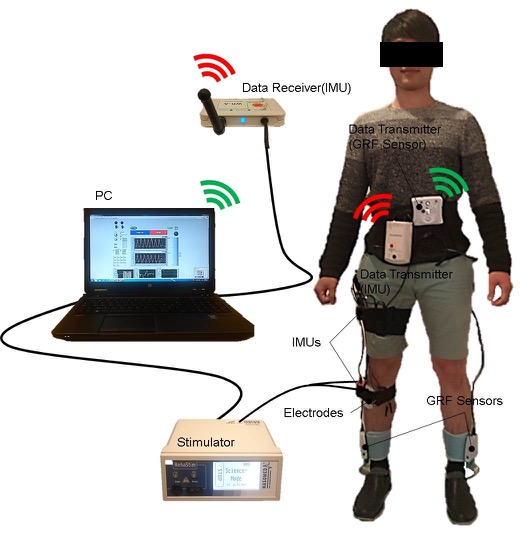
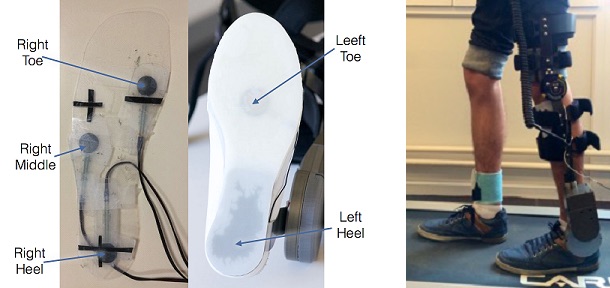
This platforms shows an adaptive knee-joint based Functional Electrical Stimulation (FES) method to correct the foot drop of paretic patients during swing phase. The rationale behind adaptive FES is to amplify dorsiflexor stimulation in the late swing when it is most needed in order to face the increased plantar flexor co-contraction as gastrocnemius muscles are stretched by knee re-extension. To accurately detect the swing phase (i.e., toes off (TO) and initial contact (IC)), a novel algorithm is proposed by using a foot-mounted inertial measurement unit (IMU). The proposed strategy is verified by experiments conducted with three healthy subjects and three paretic patients. The experimental results show that highly accurate detection of TO/IC can be achieved under different walking speeds and foot contact conditions (normal and abnormal gaits). The clinical experimental results with paretic patients also revealed that similar effects on ankle dorsiflexion can be observed during mid and late swing using the proposed adaptive FES with respect to the standard FES ON/OFF method, while the adaptive FES used lower stimulation intensity.

References
  • [1] W. Huo, V. Arnez-Paniagua, M. Ghedira, Y. Amirat, J-M Gracies, and S. Mohammed, “Adaptive FES Assistance using a Novel Gait Phase Detection Approach”, IEEE/RSJ IROS 2018, Accepted.
  • [2] W. Huo, M. Ghedira, S. Mohammed, V. Arnez-Paniagua, E. Hutin, J-M Gracies, “Effect of knee joint angle-based, adaptive functional electrical stimulation of the peroneal nerve in spastic paresis. A case report”, Annals of Physical and Rehabilitation Medicine, 61, e475-e476, 2018.
Adaptive Functional Electrical Stimulation (FES) Setup for Foot-Drop Paretic Patients
Adaptive Functional Electrical Stimulation (FES) test with paretic patient for foot-drop correction